In this article
One study found a mobile site 0.1 seconds faster raised travel conversions by 10.1%.
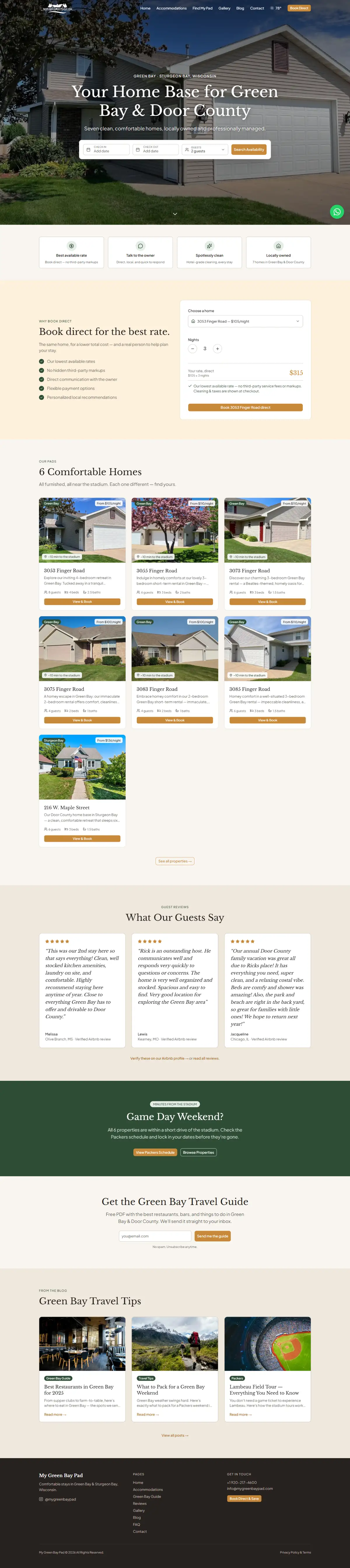
The short answer: Your first page should show a great photo and a one-line promise, then dates, price and a Book button without scrolling on a phone. Show the total price including required fees, which US rules for short-term lodging now require. Add reviews, your cancellation terms, a reason to book direct, a safe payment page, easy contact and a fast, mobile-friendly design. Speed matters: one study found a 0.1 second faster mobile site raised travel conversions by 10.1%.
Most guests will not read your whole website. They will glance at the first page, usually on a phone, and decide in a few moments whether to keep going.
So the first page has one job: make the next step obvious. Here is a checklist you can use today, whether you build the site yourself or hire someone.
What goes on the first page of a rental website?
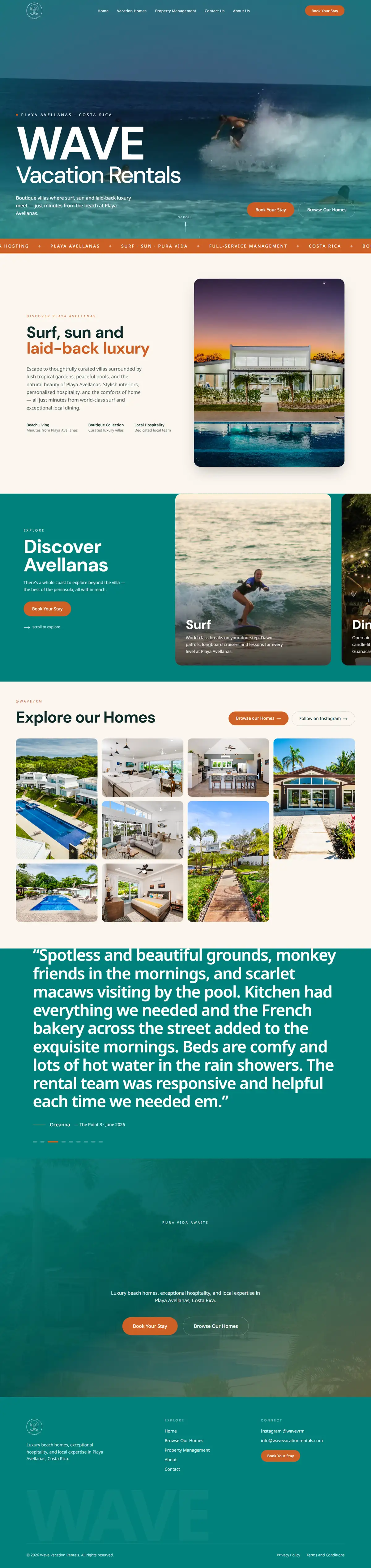
- 1. A big, true photo and a one-line promise. For example: "A lakeside cabin for six, 10 minutes from town." Use your own photos, not stock pictures.
- 2. Dates, guests, price and a Book button, without scrolling. Check it on a phone. If the Book button is hidden, you are losing bookings.
- 3. The total price, including required fees. More on this rule below.
- 4. A reason to book direct. A short line such as "Book direct and save", or a free perk. See should you offer a discount for booking direct?.
- 5. Real reviews, with a first name and a date. Show a few of your best, right on the page.
- 6. Your cancellation terms in plain words, shown before the guest pays. This also protects you if a guest disputes a charge (see chargebacks on vacation rentals).
- 7. A safe payment page. Guests pay on a trusted payment page, so you never handle a card number.
- 8. An easy way to ask a question. A phone number, WhatsApp or chat. A quick answer wins the booking.
- 9. A sign-up box for your list. It is how you bring guests back (see how to turn past guests into repeat bookers).
- 10. Speed. A page that loads slowly loses people before they see anything.

Do you have to show the total price?
In the US, the FTC's Rule on Unfair or Deceptive Fees has covered short-term lodging, including vacation rentals, since May 12, 2025. The price you show upfront has to include all the required fees you know about.
The FTC says a seller "has to be upfront and tell the truth about the fees they charge", and must tell the buyer about any fees it cannot work out in advance, such as some taxes, before asking for the final payment. The rule does not ban any fee. It asks you to be honest about the total. Civil penalties can apply.
In practice, a fee that every guest must pay, such as a mandatory cleaning fee, is the kind of charge to build into the price you show, not add on the last page. The FTC's page does not name cleaning fees, so ask a lawyer how the rule applies to yours. This is general information, not legal advice.
It is also just good selling. A guest who sees a clear total trusts you, and a guest who finds a surprise fee at the end leaves.
How fast should a rental website load?
A study called Milliseconds Make Millions found that making a mobile site just 0.1 seconds faster raised conversion rates by 10.1% on travel sites. It is one study of a set of retail and travel sites, so do not promise yourself that exact number. The direction is what matters: faster is better.
Google gives three targets, called Core Web Vitals (web.dev):
- Loading: the main content appears within 2.5 seconds.
- Response to taps: the page reacts in 200 milliseconds or less.
- Stability: things do not jump around as the page loads (a score of 0.1 or less).
Test your page for free with PageSpeed Insights. Big photos are the usual cause of slow pages, so ask whoever builds your site to size them properly.
Can your rental show up in Google's vacation rental listings?
Google has a way to show vacation rentals in Search with photos, location, rating and reviews. It is called vacation rental structured data. Google says it is an early adopters programme. To use it, your site must be connected with a Google Technical Account Manager and have access to Google's Hotel Center, and you must meet its eligibility rules. Filling in Google's interest form does not guarantee a place.
So it is not something every owner can switch on today. But the details Google asks for are the same things a good first page should already have, so you can get ready now:
- A clear name for the property
- At least eight good photos
- The exact location
- How many guests it sleeps
- Real ratings and reviews
- A unique ID for each home
A site with these details in place is ready if Google opens the programme to you, and it is already easier for guests and search engines to understand.
What should you leave off the first page?
- Pop-ups that cover the page the moment it opens
- Music or video that plays by itself
- Long blocks of text above the Book button
- Prices that hide fees
- Photos that do not show the real place
A quick test you can do in five minutes
- Open your site on your phone. Can you see the price and the Book button?
- Ask a friend to look at the first page for five seconds. Then ask: what is this, where is it, and what would it cost? If they cannot say, simplify.
- Run PageSpeed Insights and note the score.
- Book a stay on your own site, start to finish, with a real card, then refund it.
Or let us build it
You can use this checklist on any site. If you would rather not build it yourself, that is exactly what we do, and we build your first page around this checklist. Launch Pad is a custom booking website, synced with your booking tool, with 1 year of hosting included. It is $999 to set up, ready in 7 working days or it is free, and you pay the other half only when you go live.
Compare the options in how much a direct booking website costs, or pay your first installment and we start building.
Not sure what is possible for you? Ask us
On a call, we will:
- Test your first page for speed and walk through it against the ten-point checklist.
- Tell you what to fix first, and what we would build for you.
- Point out where your price display may need a lawyer's check against the FTC fees rule.
We will tell you honestly what is realistic. We do not promise results, because nobody honest can.
Common questions
- What should the first page of a vacation rental website include?
- A true photo and a one-line promise, then dates, guests, the total price and a Book button without scrolling on a phone. Add real reviews, your cancellation terms, a reason to book direct, a safe payment page, an easy way to ask a question, a sign-up box and a fast, mobile-friendly design.
- Do I have to show the total price including fees?
- In the US, the FTC's Rule on Unfair or Deceptive Fees covers short-term lodging, including vacation rentals, and requires the upfront price to include all the required fees you know about. Rules differ by country, so check where you operate. This is not legal advice.
- Can my vacation rental show up in Google Search with photos and reviews?
- Google has vacation rental structured data that can show listings in richer ways, with images, location, rating and reviews. It is an early adopters programme: you need a Google Technical Account Manager and access to Hotel Center, and an interest form does not guarantee entry. Source: Google.
- How fast should my rental website load?
- Google's Core Web Vitals say the main content should appear within 2.5 seconds, the page should react to taps in 200 milliseconds or less, and it should not shift around while loading. You can test your page for free with PageSpeed Insights.
- Why does my vacation rental website need to work on a phone?
- Many guests look at places on a phone. A study of retail and travel sites found that a mobile site just 0.1 seconds faster raised travel conversions by 10.1%, so a slow or hard-to-use mobile page costs bookings.
Sources and helpful links
- FTC: what the Rule on Unfair or Deceptive Fees means for you — total price and required fees, including vacation rentals
- FTC: the Fees Rule takes effect on May 12, 2025 — short-term lodging is covered
- web.dev: Milliseconds Make Millions — how site speed affects conversions
- web.dev: Core Web Vitals — Google's speed and stability targets
- Google: vacation rental structured data — how Google can show rentals in Search, and what it requires
- PageSpeed Insights — test any page for free
- Stripe: security — how card payments are kept safe